3-way switch circuits -- Variations
Here are several variations of using 3-way switches to control lights from two locations. Colors are shown consistent with the NEC. Before reading this page, you may want to visit 3-way switches and 4-way switches.
Single light circuits
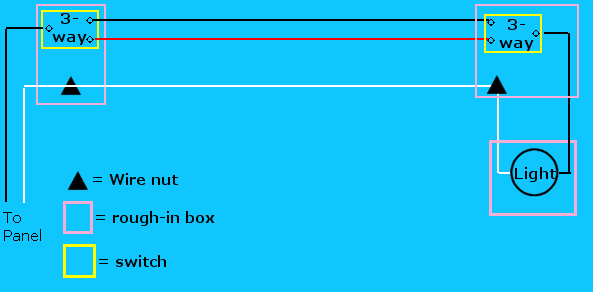
Below is perhaps the simplest arrangement, panel to switch to switch to light:
Below is a variation with the light between the two switches, i.e., panel-switch-light-switch. [See Note 1 below if the two switches are not visible from everywhere in the room illuminated by this light.] In this case, the end of the white wire from the light box to the right switch must be re-marked black to indicate that it is a hot wire:
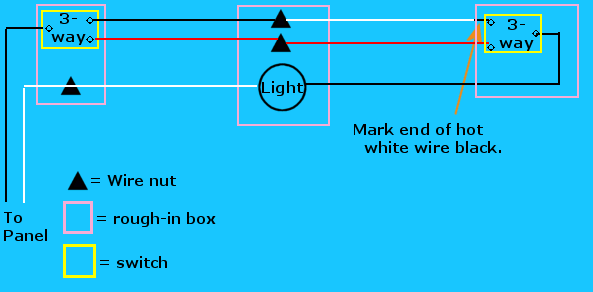
Next is a circuit with the light between the two switches, but with the panel feeding the light box. Note similar remarking to above. [See Note 1 below if the two switches are not visible to each other.]

Controlling More than one light
Any of the above can be modified to control multiple lights. Additional lights are just wired in parallel with the first, using two conductor cable. The black should be connected to the black wire feeding the light and the white to the white wire feeding the light in all cases. Here is one example. [See Note 1 if the two switches are not visible to each other.]

Here is a rather different arrangement that requires 3-conductor cable between lights. [See Note 1 if th two switches are not visible to each other.] :

Just showing off
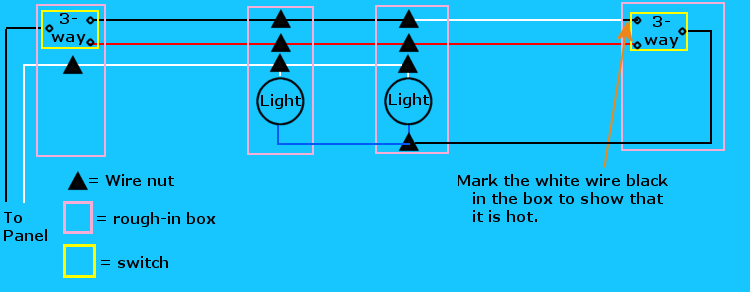
Occasionally, someone will ask if it is possible to wire a circuit that connects panel-switch-light-light-switch. It is, but you need to use four-conductor cable, as seen below. Generally it is cheaper to just wire the second light in parallel with the first using two-conductor cable, as shown earlier on this page.[See Note 1 below if the two switches are not visible from each other.]
Note 1: required neutrals in switch boxes
Beginning with the 2011 National Electric Code, in most cases every switch box must contain a neutral wire. Several of the circuits above -- those referring to this note -- do not. Fortunately, many installations of 3-way switches fall under the following exception. "Where multiple switch locations control the same lighting load such that the entire floor area of the room or space is visible from the single or combined switch locations, the grounded circuit conductor shall only be required at one location." See NEC 404.2(C) for other less common exceptions. If none of these exceptions apply, you will need to use a cable with more conductors to provide a neutral to every switch box.
Example: In the second circuit on this page, a 4-conductor cable (red, blue, black, white) should be used between the light box and the right-most 3-way switch. The white traveler shown in this circuit should be replaced with the blue wire. The white wire should instead be connected to the white from the panel in the light box, providing the neutral to the right-most switch box. It should be capped with a wire nut in that box.
<Previous: How 4-way switches work -- an animation | Main Switches Page | Next: 4-way switch variations>
- 3-way switches and 4-way switches
- 4-way switches -- an animation
- Multiple lights and multiple switches
- Miscellaneous tips and info
- Rick Matthews' home page